Texas’s U.S. Senate race has two very different money stories. From October 1 through 14, James Talarico’s principal campaign committee reported $17.6 million coming in, compared with $2.8 million for Ken Paxton’s. Those matched reports include transfers from other authorized campaign accounts, not just new donations. Read the campaign-account records.
Outside the campaigns, political organizations reported far more spending supporting Paxton or opposing Talarico: $298.7 million, versus $73.0 million in the reverse positions. Based on FEC filings RECON collected through October 23, 2026, these figures describe reported spending allocations at that cutoff, not the election’s final spending total. An allocation is the amount a filer assigns to a candidate position; it is not necessarily the cost of a separate ad. Read the dated outside-spending table.
That difference matters because a campaign’s bank account tells only part of the financing story. Outside committees can report large expenditures of their own. Their spending is not money received by the candidate, and the two sets of figures cover different periods. They cannot be added together.
To understand the system, RECON followed selected records beyond campaign accounts: from donors to political committees, and separately from an advertiser to an advertising agency and a television station. The records identify who reported providing money, which companies handled parts of the operation, and what one Houston station says it aired. They do not trace one donor’s dollars through every stage.
The broad contrast is not a new discovery. The Texas Tribune’s October 1 reporting explained the campaign-fundraising and outside-spending split. The Houston Chronicle’s political-donor project mapped major backers on both sides. RECON’s contribution is a linked reconstruction of selected original filings and station records, with the gaps left visible.
What the campaigns reported
“Receipts” means money reported coming into a committee. “Disbursements” means money reported going out. Neither term means advertising alone.
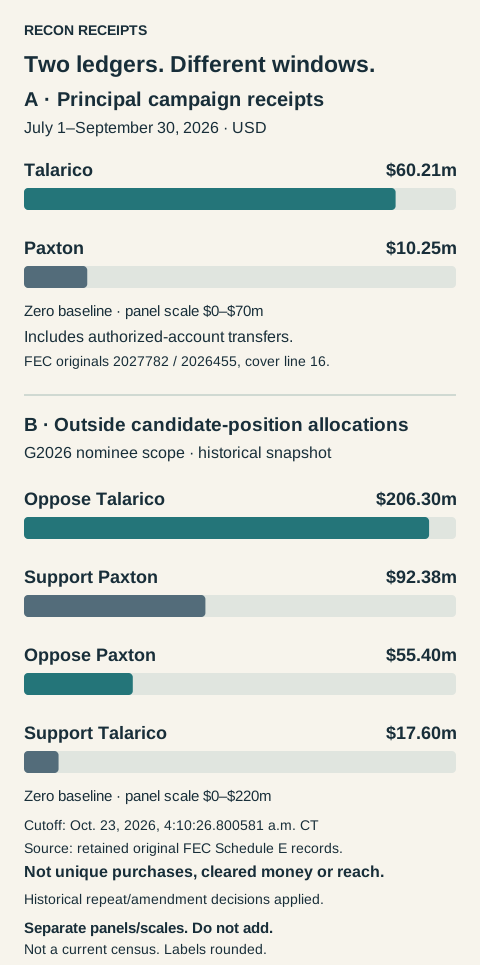
Talarico’s principal account reported more receipts than Paxton’s in both comparable periods examined here. In July–September, Talarico reported $60,214,961 in receipts and $67,165,828.23 in disbursements. Paxton reported $10,249,117.38 and $7,079,306.38. Readable Q3 summaries and original filings.
The next reports covered October 1–14:
| Principal campaign account | Oct. 1–14 receipts | Oct. 1–14 disbursements | Cash reported at Oct. 14 |
|---|---|---|---|
| Talarico for Texas | $17,577,076.96 | $22,248,451.41 | $9,922,857.40 |
| Ken Paxton for Senate | $2,829,664.16 | $2,970,361.33 | $4,784,408.30 |
Source: Talarico report 2039855 and Paxton report 2039468. These are the principal accounts, not a consolidated total for every authorized account. Receipts include $106,500 and $822,738, respectively, transferred from other authorized committees. Counting a transfer again as new fundraising would overstate the money raised.
What outside groups reported
The outside-spending records describe support for or opposition to a candidate, rather than money entering a campaign account. RECON retained these general-election allocations after its documented process for amendments and repeated disclosures:
| Position reported by outside spenders | Retained allocations | Reported amount |
|---|---|---|
| Oppose Talarico | 221 | $206,295,243.08 |
| Support Paxton | 294 | $92,382,987.14 |
| Oppose Paxton | 161 | $55,403,914.89 |
| Support Talarico | 543 | $17,602,418.04 |
| Total | 1,219 | $371,684,563.15 |
Based on FEC filings RECON collected through October 23, 2026. These figures describe reported spending allocations at that cutoff, not the election’s final spending total. The source matrix preserves the exact cutoff and selection rules. Primary and runoff records are separate.
Support-Paxton and oppose-Talarico allocations total $298,678,230.22. The reverse positions total $73,006,332.93. Those groupings do not imply the committees acted together. Multiple candidate lines can also describe shares of one communication, so the table is not a count of unique ads, invoices or cleared payments.
Trail one: major donors and political committees
The records show how a reported committee contribution appears on both committees’ books.
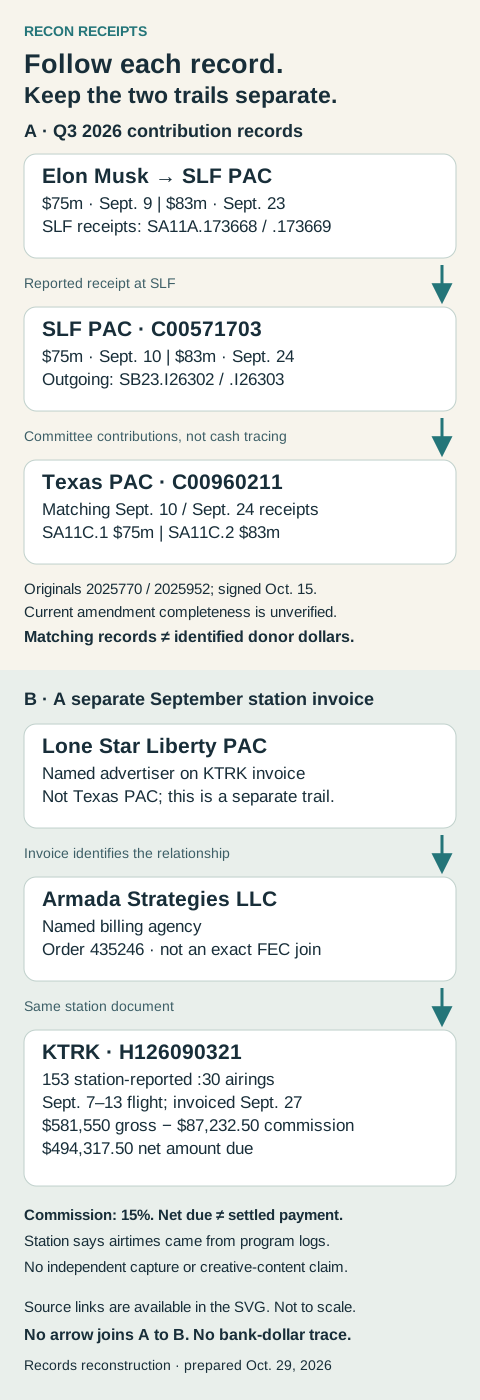
Elon Musk contributed $75 million and then $83 million to the committee historically listed as Senate Leadership Fund, now SLF PAC. SLF reported corresponding contributions to Texas PAC the following days. Texas PAC reported matching receipts. The Texas Tribune’s Gabby Birenbaum and Alejandro Serrano reported this sequence on October 15.
| Musk receipt reported by SLF | SLF outgoing contribution | Receipt reported by Texas PAC |
|---|---|---|
| Sept. 9: $75 million, SA11A.173668 | Sept. 10: $75 million, SB23.I26302 | Sept. 10: $75 million, SA11C.1 |
| Sept. 23: $83 million, SA11A.173669 | Sept. 24: $83 million, SB23.I26303 | Sept. 24: $83 million, SA11C.2 |
Sources: SLF filing 2025770 and Texas PAC filing 2025952, covering July 1–September 30 and signed October 15. Read the six transaction summaries. Each summary links to the original electronic filing. SLF is C00571703; Texas PAC is C00960211.
Each reported leg totals $158 million. SLF’s outgoing contribution and Texas PAC’s incoming receipt describe opposite sides of the same reported movement; they do not create another $158 million to add. The outgoing entries are classified as contributions to another committee, not the FEC’s separate affiliated-transfer category.
Matching dates, amounts and committee identities support this sequence. They do not tag particular dollars inside pooled accounts or identify the ad a donor’s money eventually bought. The reconstruction checks the named originals; it does not certify that no later amendments exist.
Musk also appears in a different committee’s records: America PAC reported $82.8 million in Q3 cash receipts from him and $74.8 million during October 1–14. These are separate from the SLF–Texas PAC trail. In-kind contributions and related memo entries are not more cash to add. Read the individual receipt records.
On the other side, Lone Star Rising PAC reported $5 million from Reid Hoffman and $2.5 million from Michael R Bloomberg during October 1–14. Its Q3 receipts included $1.2 million from Susan Sarofim and $1 million from Reed Hastings. These are selected reported contributions, not a complete donor ranking or proof of Texas-specific earmarks. Read the Rising receipt records.
Advertising companies handle different kinds of work
The outside-spending records name media buyers and other vendors on both sides. In the October 23 selection, Texas PAC reported $181,146,576.77 in general-election allocations for the two nominees; $152,301,076.56 named FlexPoint Media. Lone Star Rising reported $26,488,537.59; $23,450,000 named Old Town Media. The vendor amounts are already inside the committee totals. Source rows and readable examples.
The descriptions matter. FlexPoint entries include $136,141,076.56 labeled “MEDIA” and $16,160,000 labeled “DIGITAL MEDIA.” “MEDIA” alone does not establish a television buy. MAGA Inc.’s $37.2 million allocated to Del Ray Media combines connected television and digital advertising without separating those channels.
America PAC’s IMGE entries include $15,940,667.63 for “DIGITAL MEDIA” and $4,935,069.58 for “TEXTING SERVICE.” Texas Forever’s Gambit entries distinguish $8.7 million of digital buys, $6 million of estimated digital buys and $2,108,950 combining buying with production. Lower Costs Now’s Waterfront and Evolve entries also include estimated media buys. An estimate is not a final invoice or proof of bank settlement. Category details and original filings.
Other spending buys field work rather than ads. Progressive Turnout Project’s $314,624.77 in allocations naming Merrimack Services is described as field organizing. Calling every outside-spending dollar an advertising purchase would hide that distinction.
Google and Meta’s public ad libraries offer evidence of sponsor activity, individual creative identifiers and approximate spending or impression ranges. They do not necessarily identify the agency behind a purchase. RECON has not matched an identified Google or Meta creative to a specific IMGE transaction. Lifetime ranges also cannot be treated as spending during one selected week. Platform records and limits.
Trail two: an advertiser, an agency and a station
KTRK’s invoice names Lone Star Liberty PAC as advertiser and Armada Strategies LLC as billing agency. It identifies order 435246 and 153 station-reported 30-second airings, September 7–13. Read the station-record summary or the original invoice, pages 1 and 10.
The billing is reproducible: $581,550 in gross charges, minus $87,232.50 in agency commission, leaves $494,317.50 net amount due. The commission is 15%. The invoice was dated September 27; its billing period is August 31–September 13, distinct from the listed September 7–13 airings.
That is evidence of a station-reported advertising operation and its billing. It is not independent off-air verification, a measure of who watched, or proof the bill cleared a bank account. “Net amount due” means an amount billed. The invoice does not identify a matching FEC transaction or the donor who funded it.
Liberty’s Q3 receipts include $10 million from the Elon Musk Revocable Trust and $5 million from SLF PAC. Those wider funding relationships are documented, but they do not establish who funded this KTRK invoice. Read the Liberty contribution records.
Liberty’s bookkeeping also shows why records cannot simply be added. It reported a September 7 program as $8,200,420 in candidate allocations, a $7,521,600 partial disbursement and $678,820 of debt. The latter two equal the first. Adding all three would double the reported program cost. Neither the arithmetic nor the reported disbursement establishes bank clearing or a KTRK-specific share. Read the four accounting entries.
Separate KPRC records provide campaign-side examples. Revised orders and invoices list 88 spots for a Talarico-named advertiser and 31 for a Ken Paxton Victory Fund-named advertiser. Displayed zero balances do not reveal whether cash, credit or another adjustment settled the accounts. The latter advertiser’s exact federal committee mapping remains unresolved. Nor do the records establish that a saved online video was the broadcast copy. Station summaries and original invoices.
What the records explain—and what they leave open
The Tribune and Chronicle have documented the broad financing story. WIRED covered America PAC’s financing and activities; the Washington Post examined campaign advertising themes. RECON does not claim to have discovered the donor sequence or the fundraising/outside-spending reversal.
Its independent work is the reconstruction readers can inspect: reciprocal contribution records, spending categories and a station invoice with reproducible row counts and gross-to-net arithmetic. These records do not establish misconduct, coordination, purchased editorial coverage or an effect on the election result.
Three limits remain material. Later filings and amendments can change the dated spending picture; an incomplete October 26 collection is not presented as a newer complete total. The selected donor records do not identify every ultimate funder, net out every refund or reconcile all joint-fundraising accounts. And final agency orders, credits, remittance records and creative-linked delivery reports would be needed to connect more of the chain.
The public record can identify reported donors, committees and payees—and, in selected station records, what a broadcaster says it aired. It cannot yet take a particular dollar all the way to a particular viewer. That is a limit of the evidence, not a finding of wrongdoing.
Coverage: Campaign-account comparisons use July 1–September 30 and October 1–14, 2026. The outside table is based on FEC filings collected through October 23; it excludes primary, runoff and other election codes. The SLF crosswalk checks identified Q3 originals, not a complete current amendment census. KTRK’s listed airings are September 7–13; platform observations retain their preserved October dates. The source matrix and methodology retain exact acquisition timestamps, original files, reporting scopes and verification limits. Readable filing summaries are RECON’s presentations, not official FEC documents.